
Decision Support With BayesiaLab
Explore the Consequences. Then Choose.
Compare actions before you commit. Bring knowledge from LLMs, data, and experts into explicit Bayesian network models, then use BayesiaLab to examine uncertainty, simulate interventions, and evaluate your options.
- Causal Reasoning
- Explicit Models
- Human Judgment
The Decision Support Problem
What Happens If You Act?
Launch a product, change a policy, invest in capacity, or repair a critical component: you must choose before the consequences are known. An all-knowing oracle would tell you the outcome under every available action. A model is our practical substitute.
Useful decision support makes that model available for examination. It represents what you know, calculates what follows, and lets you change an assumption to see how the analysis changes. Its answers remain conditional on the knowledge and assumptions it contains.
A good outcome and a good decision are different things. Examine the basis of the choice while you can still choose differently.
From Prediction to Intervention
Seeing an Action Is Different From Taking It
Suppose components that received maintenance failed more often. Did maintenance make things worse, or were the components already in poor condition? Predicting failures from the records and estimating the effect of maintenance are different tasks.
What Does the Record Tell Us?
How likely is failure among components that received maintenance?
Observing maintenance can also tell us about the condition that prompted it. Both the selection process and maintenance itself may help explain the observed failure rate.
Conceptual illustration. A Bayesian network supports intervention analysis when its causal interpretation is justified. A graph learned from observational data is not automatically a causal model.
A Practical Workflow
Make Knowledge Explicit. Calculate Its Implications.
Frame the Choice
Define the actions, uncertain conditions, possible outcomes, and what those outcomes are worth to the decision maker.
Build the Domain Model
Combine data, expert judgment, and LLM proposals in named variables, relationships, and probabilities. Review the proposed causal mechanisms.
Compare Consequences
Use the model to update probabilities, simulate interventions, and examine how different assumptions change the possible outcomes.
Evaluate the Options
Add decisions and utilities with influence diagrams. Compare expected utilities, examine risk, and consider whether more information could improve the choice.
The model calculates with the knowledge and preferences you specify. People assess that knowledge, determine what matters, and take responsibility for the decision.
Put the Approach to Work
Build Your Decision Model in BayesiaLab
BayesiaLab provides the modeling environment for turning this approach into practice: construct Bayesian networks, inspect probability tables, enter evidence, perform causal analysis, and evaluate decisions and utilities. Keep the model available for further questions and revisions.
LLMs and Hellixia
Help Construct the Model
Language models can propose variables, mechanisms, and numerical assessments. Hellixia brings generative AI into BayesiaLab to assist with model construction from prompts and documents. Review those contributions with domain expertise and evidence.
BayesiaLab
Quantify, Calculate, and Revise
Use an explicit probability model to calculate related answers from a common representation. Examine the effects of actions under causal assumptions, explore sensitivity, and connect uncertain outcomes to decisions and utilities.
HellixMap
Explore and Share the Structure
Create, navigate, and share knowledge maps in the browser. Explore graphs generated with Hellixia or published from BayesiaLab, and make the represented relationships easier for others to examine.
For browser-based numerical inference and scenario simulation with a BayesiaLab model, explore WebSimulator.
Discover WebSimulatorDecision Support in Practice
Start With a Question Like Yours
Explore existing BayesiaLab tutorials, recorded webinars, and model examples. Each shows a different part of the work, from diagnosis and uncertain forecasts to policy choice and optimization.
Diagnosis and Repair
What Should We Check or Repair Next?
Combine an expert-built engine model with diagnostic and repair costs, then adapt the next step as new evidence arrives.
Business Planning
How Should We Plan Under Uncertainty?
Explore a business forecast with uncertain inputs, inventory, and costs, and share the model through a browser-based scenario interface.
Energy and Infrastructure
Which Energy Mix Meets Our Requirements?
Combine demand and weather data with physical constraints and expert assumptions to compare energy mixes and examine sensitivity.
Budget Allocation
How Could We Allocate a Media Budget?
Connect advertising and sales data with explicit causal assumptions, cost functions, and budget constraints to explore allocation choices.
Policy Analysis
When Should a Policy Change?
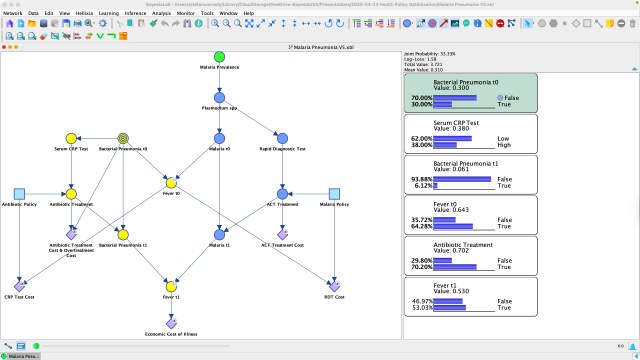
Examine a historical educational example of malaria and pneumonia treatment policies under uncertain prevalence and test performance.
LLMs to Explicit Models
How Can a Question Become a Model?
Follow an EV battery supply-chain example from a question through Hellixia and HellixMap to a quantified BayesiaLab model. An illustration for review, not a validated industry analysis.
An Adjacent Starting Point
Key Driver Analysis: What Matters, and What Could We Change?
Key Driver Analysis helps investigate relationships with an outcome such as satisfaction or loyalty. Bayesian networks and probabilistic structural equation models provide a framework for that analysis. Turning a driver finding into an action recommendation requires a further account of causality, feasible changes, costs, and preferences.
The Discussion Paper
Decision Support and the Search for an Oracle
Large Language Models, Bayesian Networks, and Deliberative Reasoning
Stefan Conrady · Bayesia USA
Read the argument behind the approach: what decision support requires, how causal questions differ from predictions, and how LLMs and explicit models can contribute complementary capabilities. The paper develops a methodology; it does not claim that combining these tools guarantees better decisions.
The paper is being finalized. The final PDF will be available for download here.
A companion tutorial is planned. You can explore the existing worked examples above today.
Bring Your Decision Problem Into Focus
Explore BayesiaLab with your own questions, or talk with us about modeling the actions, uncertainties, and outcomes that matter to you.