
Monitor Temporal Evolution
Context
Monitor Temporal Evolution applies to nodes connected through a temporal relationship. It records selected state probabilities or values as the network advances through time.
See Arc Management: Creating a Temporal Arc for the setup procedure.
“Temporal” refers to relationships across time steps. It does not mean “temporary.” Relationships within the same time step are contemporaneous.
The example below represents a binary process with and as consecutive time slices. The dashed arc is a Temporal Relation. The red node border identifies the temporally monitored node.
Usage
- In Modeling Mode, clear any other highlighted nodes and open Node Contextual Menu > Monitor Temporal Evolution on the node you want to configure.
- In Temporal Evolution Monitoring Editor, enable Temporally Monitored.
- Choose Monitor Value/Mean and/or the desired states in the Monitored column. In the illustrated example, only state is selected.
- Choose OK to apply the settings.
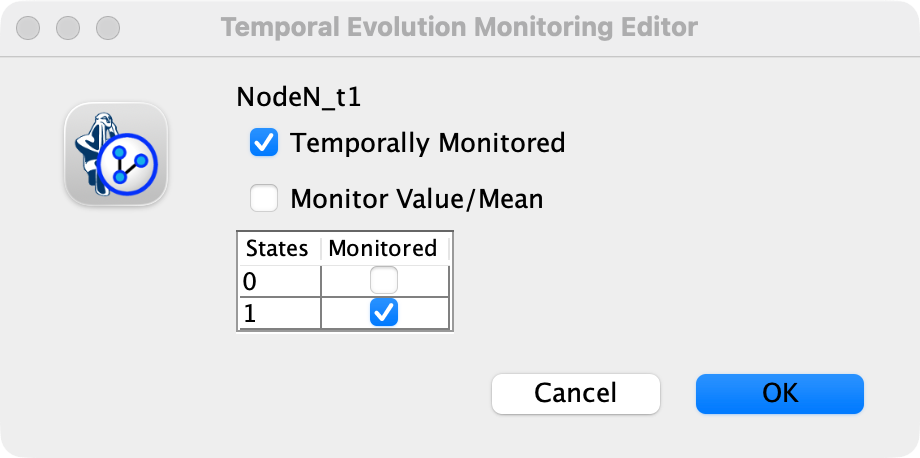
When enabling monitoring for the first time in this example, BayesiaLab selected the value/mean option and both states. Clear the unwanted series before confirming the dialog.
Following the evolution
Switch to Validation Mode. Use Step in the Temporal Toolbar to advance the network, then Show Graph to display the recorded series. Reset Time returns the example to its initial time.
The example starts with in state with certainty. The transition keeps state with probability 0.9 and never changes state back to . Therefore the next-node probability is initially 90%, then 81% after one Step, and about 31.3811% after ten Steps.
The graph’s legend value, 56.142769%, matches the arithmetic mean of the eleven displayed probabilities; it is not the final point’s probability.