Missing Values Processing
Context
Missing values are encountered in virtually all real-world data collection processes. Missing values can be the result of non-responses in surveys, poor record-keeping, server outages, attrition in longitudinal surveys, or faulty sensors of a measuring device, etc. Missing values processing beyond naive ad hoc approaches can be a demanding task, both methodologically and computationally. Traditionally, the process of specifying an imputation model has been a scientific modeling effort on its own, and few non-statisticians dared to venture into this specialized field (van Buuren, 2007) . With Bayesian networks and BayesiaLab, handling missing values properly is practically feasible for researchers who might otherwise not attempt to deal with missing values beyond the ad hoc approaches.
Usage
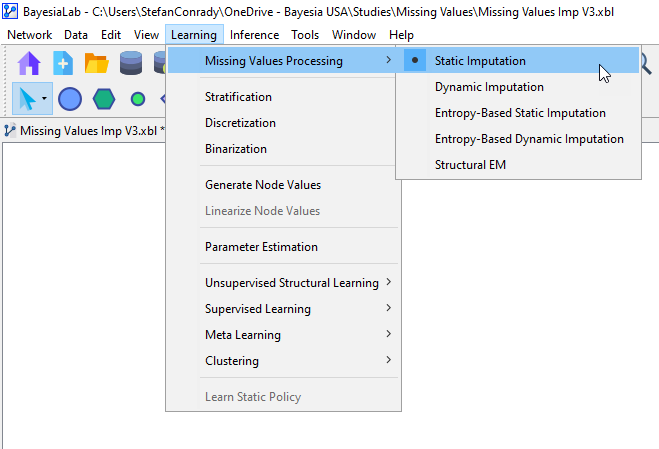
In BayesiaLab, there are multiple contexts in which to select the type of Missing Values Processing algorithm:
- In Step 3 of the Data Import Wizard, you can specify the type of Missing Values Processing as you bring your dataset into BayesiaLab. However, that selection only applies to the one-time import process.
- For the ongoing Missing Values Processing in the context of machine learning, you also need to select an algorithm, which is what we discuss here.
Select Menus > Learning > Missing Values Processing > ...
Missing Values Processing in Detail
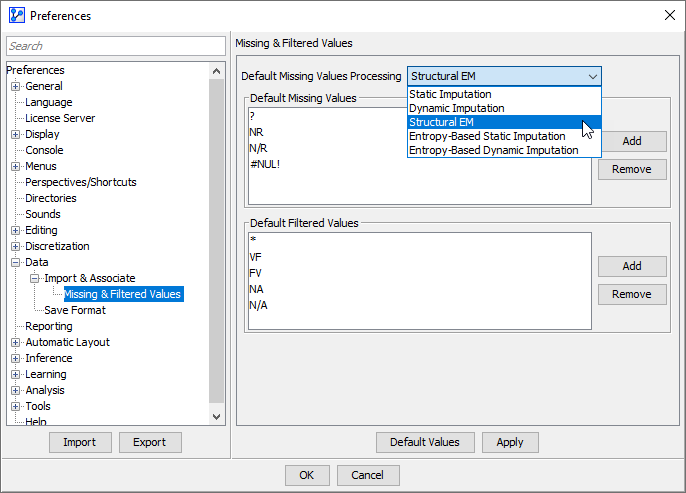
Default Missing Values Processing Algorithm
You can specify the default algorithm under Menus > Window > Preferences > Data > Import & Associate > Missing & Filtered Values.