
Most Probable Explanation
Overview
The Most Probable Explanation (MPE), also called the Maximum A Posteriori (MAP) assignment, corresponds to the fully instantiated particle that has the highest probability. If we think about the Joint Probability Distribution as a hypercube, the MPE is the cell with the highest probability.
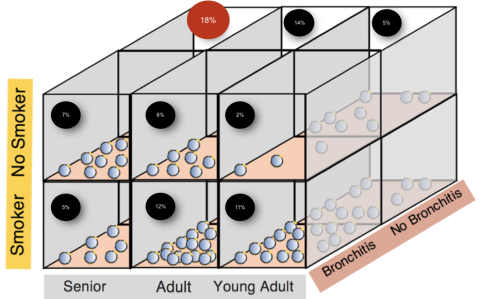
The cube above represents the Joint Probability Distribution of the domain defined by this network, 12 unique events (2 x 2 x 3). These joint probabilities sum to 100%. The probability highlighted in red indicates the marginal MPE. Seniors who do not smoke and do not have bronchitis represent 18% of the overall population modeled with this network.
MPE Mode
The tool that computes the MPE in BayesiaLab is an Inference Mode. In this mode, the Monitors no longer show probabilities, but rather the factor by which the MPE probability would be reduced if the corresponding evidence were set. The 100% states then belong to the current MPE.
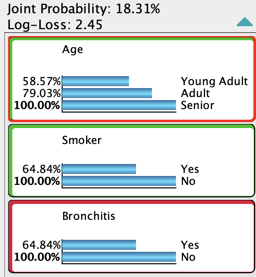
The probability of the current MPE is shown in the upper part of the Monitor Pane.
The MPE mode is interactive. All monitors are updated when evidence is set. For example, when we set Age=, this reduces the joint probability by 59%, and the new conditional MPE corresponds to smokers that have bronchitis.
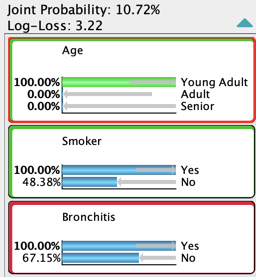
The MPE is sometimes counter-intuitive because it does not necessarily correspond to the marginally most likely state of each node.
To exit MPE mode and return the network to standard inference, click Stop Most Probable Explanation in the toolbar. This restores the regular probability display in the Monitors.
Fully Instantiated Particles
The MPE returns a fully instantiated particle. This means that all nodes are instantiated, so all dimensions of the domain have exactly the same weight. Adding irrelevant or redundant dimensions can therefore affect the result.
Returning partially instantiated particles is much more computationally expensive. This is the case with the Maximum A Posteriori (MAP), also called Marginal MAP, which returns the most likely set of particles defined on a subset of nodes, given the current set of evidence, which can be empty. It is also the case with the Most Relevant Explanations (MRE), a tool that searches for precise and concise explanations for your current set of evidence.
MPE Instantiation
A right-click on the Monitor allows you to instantiate the MPE, i.e. set the evidence on the 100% state. Since this feature is available via the Monitor Contextual menu, it works on the selected monitors only.