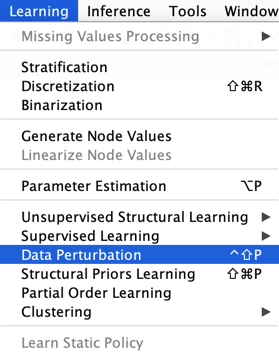
Data Perturbation
Context
In the context of Target Evaluation, Data Perturbation is the resampling method used to generate the bag of data sets on which the target node’s predictive performance is repeatedly evaluated, so that the stability of the results can be assessed.
Data Perturbation is a Smoothed Bootstrapping algorithm that randomly perturbs the weight of each particle described in the data set by multiplying the current weight by a random perturbation with values between 0 and 2. The perturbation value is drawn from a Normal distribution with a mean of 1 and a standard deviation set by the user. An internal decay factor can be used to progressively attenuate the standard deviation with each iteration in order to reach the user-defined Final Standard Deviation. When the Final Standard Deviation is set to 0, the last data set is therefore the original unperturbed data set.
The chosen learning algorithm is then run iteratively on each perturbed data set, and the MDL scores of the induced networks are evaluated on the original unperturbed data set.