
Propositional Causal Bayesian Network Generator
Overview
The Propositional Causal Bayesian Network Generator is a powerful tool for automatically building a fully specified Causal Bayesian Network that explains a selected Target Node.
Context
A Propositional Causal Bayesian Network is a fully-specified Bayesian network in which:
- Every node represents a proposition, i.e., a statement that is either or . This means all nodes are Boolean variables with exactly two states.
- Every arc represents a direct causal relationship, not just a probabilistic association.
- Each arc carries a signed direct effect, expressed as a number between -1 and +1:
- A positive value (shown in blue) means the parent’s truth promotes the child’s truth.
- A negative value (shown in red) means the parent’s truth inhibits the child’s truth.
Because all nodes are Boolean, BayesiaLab automatically generates the Conditional Probability Tables using built-in functions such as DualNoisyOr() or SwitchNoisyOr(). This makes the network fully specified and ready for probabilistic inference immediately after construction.
The term “propositional” comes from logic: a proposition is simply a statement that can be true or false. For example:
- “It is raining” → or
- “The patient has renal colic” → or
- “A safety barrier is in place” → or
By restricting every node to this Boolean form, the model becomes very interpretable and the causal semantics (promote/inhibit) become clear.
Functionality
Causal Knowledge Mining
Hellixia queries a Large Language Model (LLM) to identify the causal ancestors (and optionally descendants) of the target node. The LLM also assigns an estimated effect, a numerical value between ‑1 (negative influence) and +1 (positive influence).
Structure & Parameterization
The identified nodes and arcs are added to the graph. Conditional Probability Tables (CPTs) are automatically populated using the DualNoisyOr() and the SwitchNoisyOr() functions. The estimated direct effects serve as the per‑cause parameters of these functions.
Visual Encoding
Arcs are displayed according to the estimated causal strength: blue for positive influence, red for negative influence, with the line thickness reflecting the magnitude.
Comments
The generator also attaches comments to arcs explaining the underlying causal mechanism.
Usage
Hellixia > Propositional Causal Bayesian Network Generator.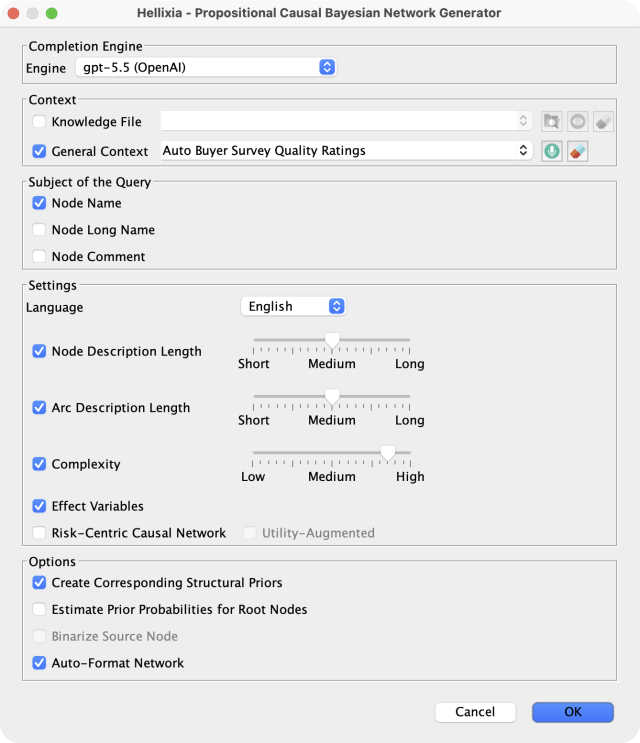
Note that the generated network works only with Boolean nodes (/ states) because the DualNoisyOr/SwitchNoisyOr functions are defined for binary variables.
Options
Risk-Centric Causal Network Generator
A version specialized for risk modeling, using predefined role types (Trigger, Control, Event, Main Risk, etc.) and constraining the structure to a risk‑centric typology.
How it differs from a plain Bayesian network
A standard Bayesian network only encodes probabilistic dependencies: an arc from A to B says “B depends on A,” but does not necessarily mean A causes B. In a Propositional Causal Bayesian Network, every arc is explicitly causal, so you can use it for causal inference: predicting the effect of interventions (via Pearl’s do-operator), not just observations. This makes it suitable for answering “what if” questions, such as: What would happen to the risk if we remove this threat?