
Cluster Interpretation: Relationship with Target Node
Background & Context
On this page, we present the Relationship with Target Node report for cluster interpretation as an alternative to Most Relevant Explanations for Cluster Interpretation.
To provide further context for Most Relevant Explanations for Cluster Interpretation, we compare several other approaches that can help interpret individual Clusters:
- Setting Evidence for Cluster Interpretation: Posterior Distributions, Relationship with Target Node, Mosaic Analysis, Posterior Mean Analysis, Segment Profile Analysis, Histograms, Tornado Diagrams,
- Optimization for Cluster Interpretation: Dynamic Profile, Target Optimization Tree
More specifically, we compare all these approaches with regard to characterizing the state of the Cluster Node in the reference network.
All analyses and instructions on this page refer to this reference network, which you can download here:

Relationship with Target Node
To produce the Relationship with Target Node report, select Menus > Analysis > Report > Target > Relationship with Target Node.
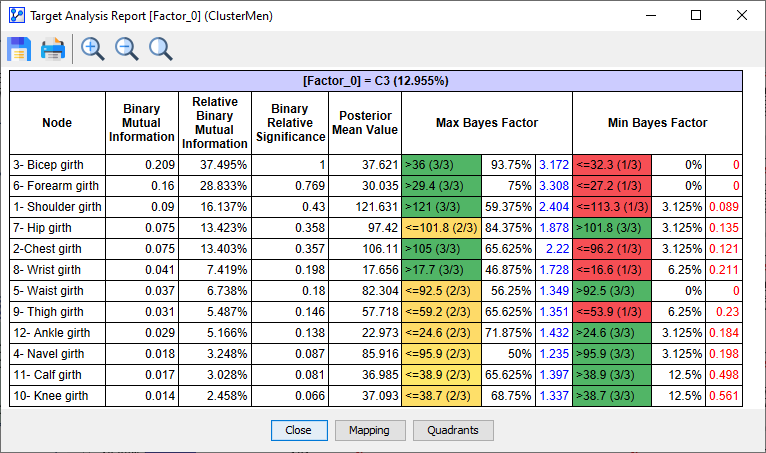
In addition to a wide range of information about the Target Node in general and other states, we obtain a list of measures specific to Cluster :
- Node: name of the node to which all measures of the row apply.
- Binary Mutual Information: the amount of information gained by observing the node regarding the Target State () of the Target Node .
- Note that in an earlier table within this report, BayesiaLab reports the Mutual Information of the node regarding the Target Node in general.
- Relative Binary Mutual Information: the amount of information gained by observing the node regarding the Target State () of the Target Node , divided by the marginal Entropy of the Target State.
- Binary Relative Significance: the proportion of the node’s Binary Mutual Information relative to the node with the maximum Binary Mutual Information. As a result, the top row always features a Binary Relative Significance of 1.
- Posterior Mean Value: the expected value of the node given Target State () of the Target Node .
- The Max Bayes Factor heading spans three unlabeled columns:
- Node State that corresponds to the maximum Bayes Factor for that node regarding Target State () of the Target Node , including the State Value (or State Name).
- Probability of the Node State with the maximum Bayes Factor.
- Bayes Factor calculated for that state.
- The Min Bayes Factor heading spans three unlabeled columns:
- Node State that corresponds to the minimum Bayes Factor for that node regarding Target State () of the Target Node , including the State Value (or State Name).
- Probability of the Node State with the minimum Bayes Factor.
- Bayes Factor of the Node State with the minimum Bayes Factor.