
A Comparison of Thomas Hobbes’ and John Locke’s Ideas on Political Philosophy
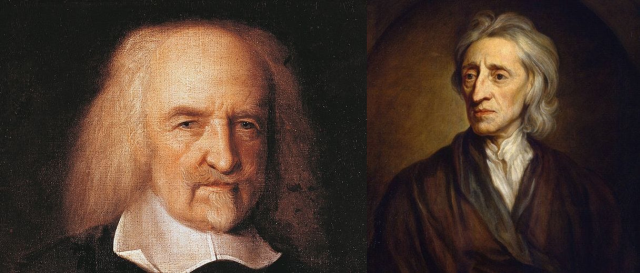
This example compares selected political philosophy concepts from Thomas Hobbes and John Locke. Hellixia is used to elicit dimensions related to their views on social contract theory, governance, human nature, rules, and divergences, then to create a semantic network that highlights areas of similarity and contrast.
Workflow for Creating a Semantic Network
Create the node .
Use the Dimension Elicitor with a broad array of keywords like “Perspectives, Rules, Divergences, Ideas, Topics, Similarities and Differences”, and set the General Context to “Political Philosophy.”
Inspect the dimensions returned by Hellixia and eliminate any that seem superfluous or unrelated to the analysis. Next, disregard the node and run the Embedding Generator on all remaining nodes to apprehend the semantic associations of their names and comments.
Use the Maximum Weight Spanning Tree algorithm to generate a semantic network.
Change node styles to Badges to ensure each node’s comment is visible. Then, apply the Dynamic Grid Layout to position the nodes on the graph; this algorithm is not deterministic, and its orientation (vertical, horizontal, or mixed) is random. You might need to execute this layout several times to obtain an arrangement that aligns with the intended presentation.
Switch over to Validation Mode F5 and select Skeleton View. Since the network does not represent causal relations, Skeleton View will maintain only node connections without indicating a direction.

Workflow for the Node Force analysis
Return to Modeling Mode F4 and alter the node styles to Discs.
Use the Symmetric Layout and switch to Validation Mode F5 to run a Node Force analysis.