Skip to Content

Knowledge Mining with Hellixia

Part of the BayesiaLab exploration path. Start with the BayesiaLab Overview, or go directly to the Hellixia User Guide for feature-level instructions.

Knowledge Mining is the process of turning unstructured or semi-structured knowledge into explicit, inspectable, and computable model assets.

In BayesiaLab, this capability is provided by Hellixia, BayesiaLab’s Generative AI assistant. Hellixia helps analysts transform prompts, expert context, and knowledge files into semantic graphs, knowledge graphs, causal networks, and Bayesian-network structures that can be reviewed, edited, learned from data, and used for inference.

Rather than leaving AI-generated output as disconnected text, Knowledge Mining moves it into BayesiaLab’s graphical and probabilistic modeling environment, where assumptions, relationships, comments, causal directions, and probabilistic scaffolding can be inspected, challenged, refined, and operationalized.

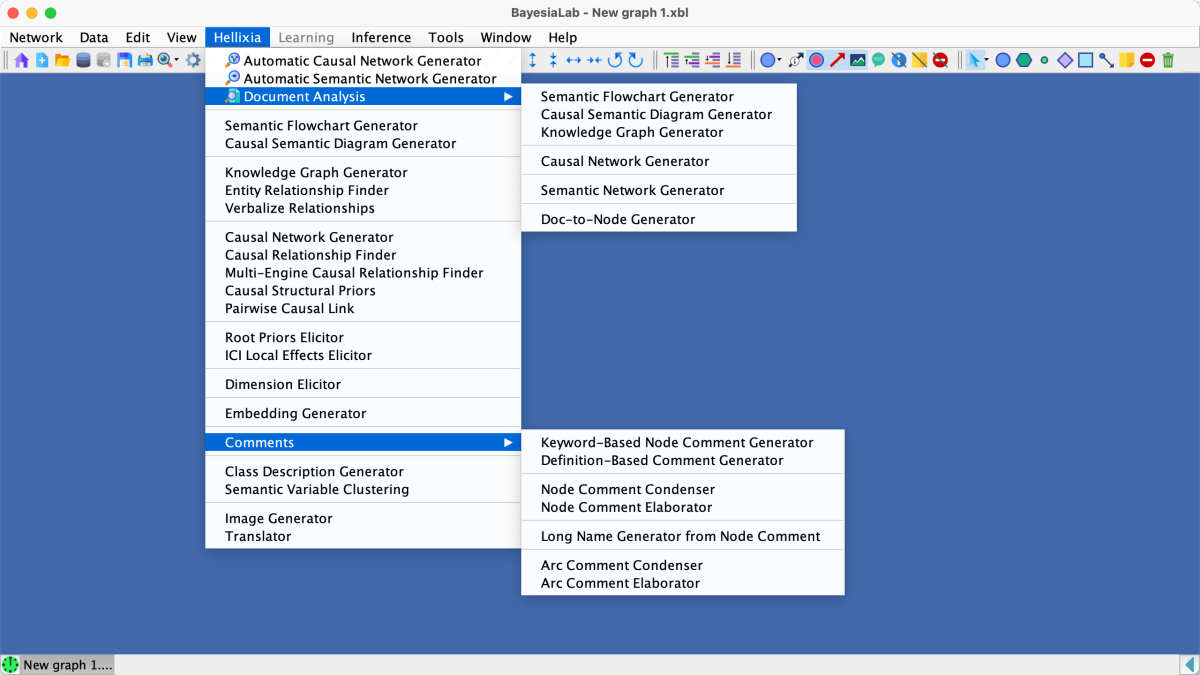
Hellixia knowledge mining tools in BayesiaLab
Click to Zoom

From Language to Model Structure

Hellixia can begin with a question, a domain prompt, selected node content, or one or more knowledge files.

Depending on the workflow, the output can include:

  • a semantic map of key concepts,
  • a knowledge graph of entities and relationships,
  • a causal semantic diagram,
  • a causal Bayesian network,
  • a risk-centric causal network,
  • or supporting model assets such as node comments, class descriptions, embeddings, translations, and visual cues.

The result is not a final answer to be accepted blindly. Instead, it provides a structured starting point for analyst review, expert critique, data-driven refinement, probabilistic reasoning, and decision-support workflows.

Prompt-to-Network Generation

Automatic Causal Network Generator

The Automatic Causal Network Generator creates an initial causal Bayesian network from a prompt-defined problem domain. It can generate nodes and arcs, add explanatory comments for causal links, retrieve beliefs about causal effects, build conditional probability tables, and format the resulting network for readability.

A Risk-Centric Causal Network option focuses the generated model on triggering events, controls, consequences, and mitigation actions.

These generated structures can serve as exploratory prototypes, analyst aids, or starting points for more formal Bayesian-network development workflows.

Automatic Semantic Network Generator

The Automatic Semantic Network Generator extracts important dimensions related to a question, generates embeddings, builds a dataset, and learns a semantic network that reflects proximity among the extracted concepts.

This is useful when the first task is not causal modeling but domain exploration: identifying the concepts, themes, and dimensions that should be considered before a more formal model is built.

Document-to-Model Workflows

Hellixia can use Knowledge Files as detailed context for LLM-based analysis. This allows analysts to move from documents, reports, articles, transcripts, or other domain materials into structured graph artifacts.

Document Analysis can generate:

  • Semantic Flowcharts, which connect key concepts according to sequential relationships.
  • Causal Semantic Diagrams, which connect concepts according to causal relationships.
  • Knowledge Graphs, which extract entities and semantic associations.
  • Causal Networks, which generate causal Bayesian networks or risk-centric causal networks directly from knowledge-file content.
  • Semantic Networks, which learn semantic proximity structures from extracted dimensions and embeddings.
  • Doc-to-Node outputs, which create one node per selected knowledge file and can learn a semantic network from the resulting node names and comments.

These outputs help analysts transform source material into model-ready structures without manually starting from a blank graph, while preserving a visible and inspectable connection between the source material and the resulting graph artifacts.

Semantic Scaffolding and Enrichment

Knowledge Mining also includes tools for enriching and organizing model elements.

These functions help analysts move from loosely structured language toward increasingly organized semantic, causal, and probabilistic representations.

Dimension Elicitor

The Dimension Elicitor helps identify relevant dimensions of a subject by querying LLMs with selected keywords and context. The retrieved dimensions can be added as nodes, with comments and optional class groupings.

Embedding Generator

The Embedding Generator creates high-dimensional semantic representations of node names, long names, and comments. These embeddings can be attached as data and used to learn semantic networks, identify semantic proximity, or support downstream semantic-analysis workflows.

Comment Generator

The Comment Generator retrieves explanatory text for selected nodes and adds it to node comments. This helps transform terse node labels into richer model elements that are easier to understand, review, and communicate.

Class Description Generator

The Class Description Generator summarizes groups of nodes or automatically generated classes. This is useful when clustering or factor-induction workflows produce groups that need meaningful names and descriptions.

Semantic Variable Clustering

Semantic Variable Clustering groups nodes according to the meaning of their names or descriptions. It can help organize large networks, survey items, feature sets, or domain vocabularies into interpretable classes.

Node Translator and Image Generator

The Node Translator supports multilingual modeling by translating node names, state names, and node comments. The Image Generator can create visual representations of nodes, helping users recognize and communicate model elements more easily.

Causal Knowledge Mining

Knowledge Mining is especially important in domains where causal structure cannot be identified reliably from data alone.

Hellixia supports causal modeling by retrieving external domain knowledge about possible causal directions and mechanisms. The Causality Analysis function can evaluate a potential causal relationship between two selected nodes and add causal links and arc comments when a relationship is identified.

The Causal Structural Priors function extends this idea to larger sets of nodes and arcs. It can generate proposed causal orientations, explanations, and structural priors that can be used to guide or constrain subsequent modeling and learning workflows.

These functions do not replace expert judgment. Instead, they provide explicit and reviewable hypotheses that analysts can accept, reject, revise, or operationalize as structural priors for downstream modeling and learning workflows.

A Typical Knowledge Mining Workflow

A Knowledge Mining workflow often proceeds as follows:

  1. Frame the domain with a question, prompt, general context, selected nodes, or knowledge files.
  2. Generate an initial structure using a semantic, causal, document-based, or risk-centric Hellixia function.
  3. Inspect and edit the output by reviewing nodes, arcs, comments, classes, and proposed causal directions.
  4. Refine the model with expert judgment, BayesiaLab modeling tools, and, when available, empirical data.
  5. Analyze, operationalize, and communicate the resulting model through inference, simulation, effects analysis, optimization, WebSimulator, HellixMap, or embedded decision-support workflows.

Typical Use Cases

Knowledge Mining is useful when analysts need to extract structure from sources that are rich in meaning but not already available as clean, model-ready datasets.

Typical use cases include:

  • strategic intelligence and geopolitical analysis,
  • risk and reliability modeling,
  • healthcare and life-science literature review,
  • policy analysis and public-health reasoning,
  • customer feedback and market-research text analysis,
  • expert-domain exploration before data collection,
  • and rapid prototyping of causal hypotheses.

Relationship to Hellixia and HellixMap

Hellixia is the BayesiaLab assistant that performs the knowledge-mining functions described here. The generated assets can be refined in BayesiaLab as Bayesian networks, semantic networks, causal structures, or operational decision-support models.

For detailed feature instructions, see the Hellixia User Guide.

For public examples and demonstrations, see Hellixia Examples.

For browser-native exploration, publishing, and sharing of semantic graphs, knowledge graphs, and Bayesian networks, see HellixMap.

Examples & Learn More