
Maximum Weight Spanning Tree
Context
The Maximum Weight Spanning Tree learning algorithm is by far the quickest Unsupervised Structural Learning Algorithm. It only relies on two passes:
- The first pass consists of computing the a priori weights of all binary relationships between all variables.
- The second pass constructs the Maximum Weight Spanning Tree of those relationships.
While the resulting network may not be optimal, it can be useful for an initial imputation of values as part of a Missing Values Processing strategy. The Maximum Weight Spanning Tree learning algorithm can be used as a first network prior to using the Taboo or EQ algorithms. Furthermore, it is a practical basis for performing Variable Clustering. Internally, the Maximum Weight Spanning Tree initially produces an undirected network. To obtain a directed Bayesian network, BayesiaLab orients the arcs so that V-structures are avoided. However, the presence of Fixed Arcs can lead to the introduction of V-structures.
The following conditions apply to the Maximum Weight Spanning Tree:
- Fixed Arcs are not protected from deletion.
- Any constraints defined through Forbidden Arcs are respected.
- Temporal Indices are taken into account.
We use the terms Maximum Spanning Tree and Maximum Weight Spanning Tree interchangeably. Both refer to the same learning algorithm.
Usage
Select Menus > Learning > Unsupervised Structural Learning > Maximum Spanning Tree. A new window prompts you to specify the learning settings:
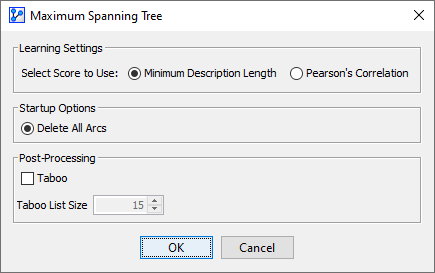
For this learning algorithm only, you have a choice between two scoring methods:
- Minimum Description Length Score.
- Pearson’s Correlation
Checking the Taboo box in the Post-Processing panel launches a Taboo search of the specified Taboo List Size in an attempt to improve the network beyond the initial solution found by the Maximum Weight Spanning Tree. The principle of the Taboo search is to permit the score to deteriorate, which is normally “taboo”, with the objective of finding a better solution beyond the immediate local optimum.