
Cartographer of Causality: Mapping Tocqueville’s Thought with AI and Bayesian Networks
Recorded on April 29, 2026
Webinar Recording
Abstract
Alexis de Tocqueville, the 19th-century author of Democracy in America, remains one of the most perceptive analysts of modern democracy, showing how institutions, beliefs, and social conditions shape long-term political outcomes. Crucially, he was already thinking in causal structures, even if he lacked the formalism to represent them.
A Provocative Experiment
In this webinar, Dr. Lionel Jouffe explores that idea through a simple but provocative experiment: How far can one go in reconstructing a major work of political thought from a single open-ended question?
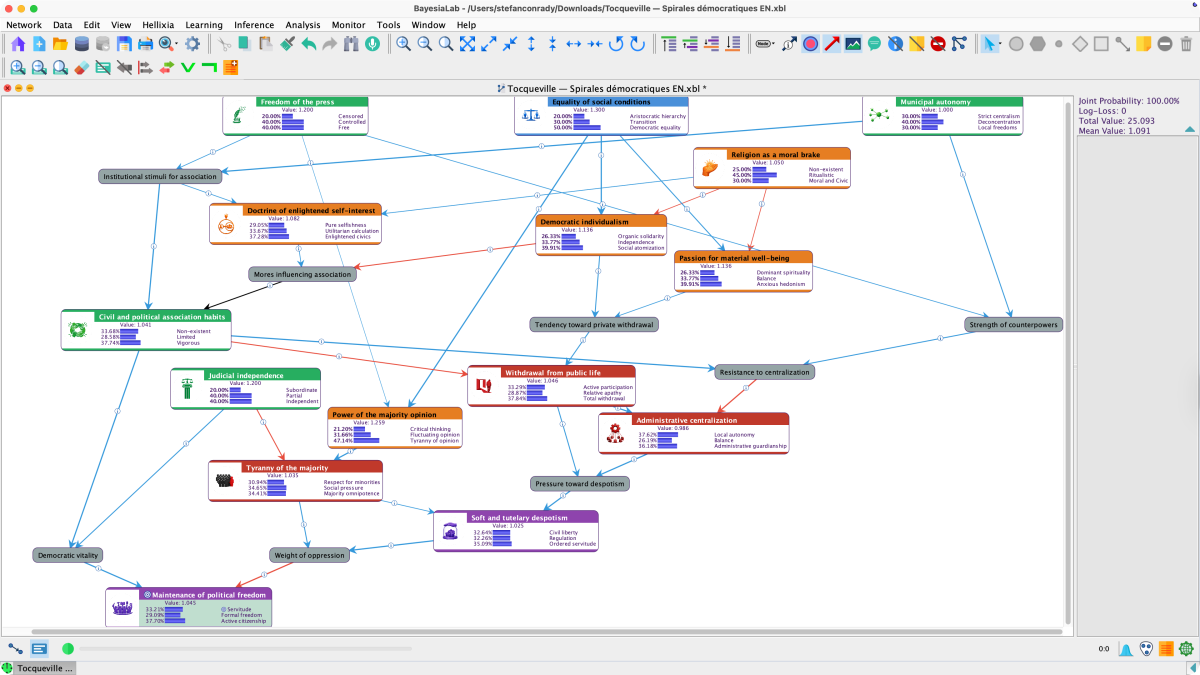
Starting only with the prompt “Democracy in America, Alexis de Tocqueville,” we use AI-assisted knowledge elicitation to generate a sequence of increasingly structured representations of Tocqueville’s conceptual universe.
Seven Complementary Models
Without relying on a predefined corpus, we progressively map his ideas into seven complementary forms:

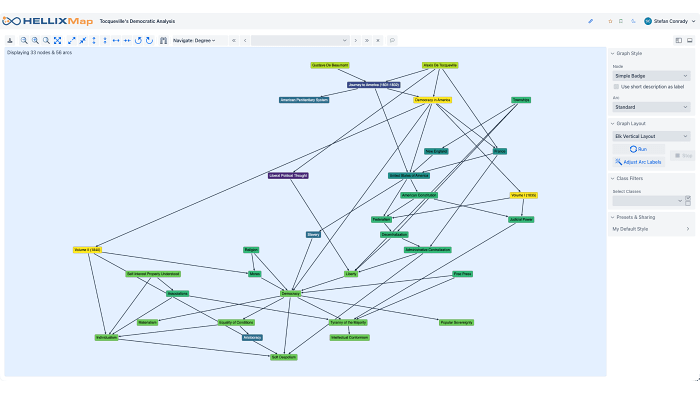


Each model is partial. Each model is imperfect. But together, they reveal the internal structure of a profoundly systemic thinker.
Tocqueville’s Causal Method
Tocqueville was not merely an observer of democracy. He was, in effect, a cartographer of political causality. In Democracy in America, the word “cause” appears 270 times, and “effect” 148 times. Causality is not a modern reinterpretation of his work; it is central to his method.
What was missing in the 19th century was not insight, but formalism.
From Language to Formal Structure
Today, generative AI provides a means to elicit structured knowledge from language, while Bayesian networks provide a rigorous framework for representing causal relationships, uncertainty, and inference. Together, they allow us to translate Tocqueville’s implicit reasoning into explicit, analyzable models.
Making Structure Visible
This is not an attempt to replace philosophy with AI. Rather, it is an effort to make visible the structure that philosophical inquiry already contained, revealing how narrative insight can be transformed into formal causal architecture.
About the Presenter
Dr. Lionel Jouffe
Dr. Lionel Jouffe is co-founder and CEO of France-based Bayesia S.A.S. Lionel holds a Ph.D. in Computer Science from the University of Rennes and has worked in Artificial Intelligence since the early 1990s. While working as a Professor/Researcher at ESIEA, Lionel started exploring the potential of Bayesian networks. After co-founding Bayesia in 2001, he and his team have been working full-time on the development of BayesiaLab. Since then, BayesiaLab has emerged as the leading software package for knowledge discovery, data mining, and knowledge modeling using Bayesian networks. It enjoys broad acceptance in academic communities, business, and industry.