
Partial Ordering
In a Partial Ordering, the index of a node is incremented only when it has parents in the Essential Graph.
All nodes in a tree structure have an index equal to 0 unless expert knowledge has been added to the graph to disambiguate the directions of edges. There are three ways to incorporate such knowledge: fixed arcs, forbidden arcs, and Temporal Indices.
This function converts the current graph into an Essential Graph and computes the partial ordering of the nodes. The node indices are returned in a table and saved as Temporal Indices.
Example
Consider the network below.

Without any expert knowledge, the relationships between N1, N2, and N3 are undirected in the Essential Graph.

Any of the following makes the Essential Graph identical to the initial network: fixing the arc, forbidding the arc, or associating a temporal index of 0 for N1 and 1 for N2.


Example
Consider the following network.
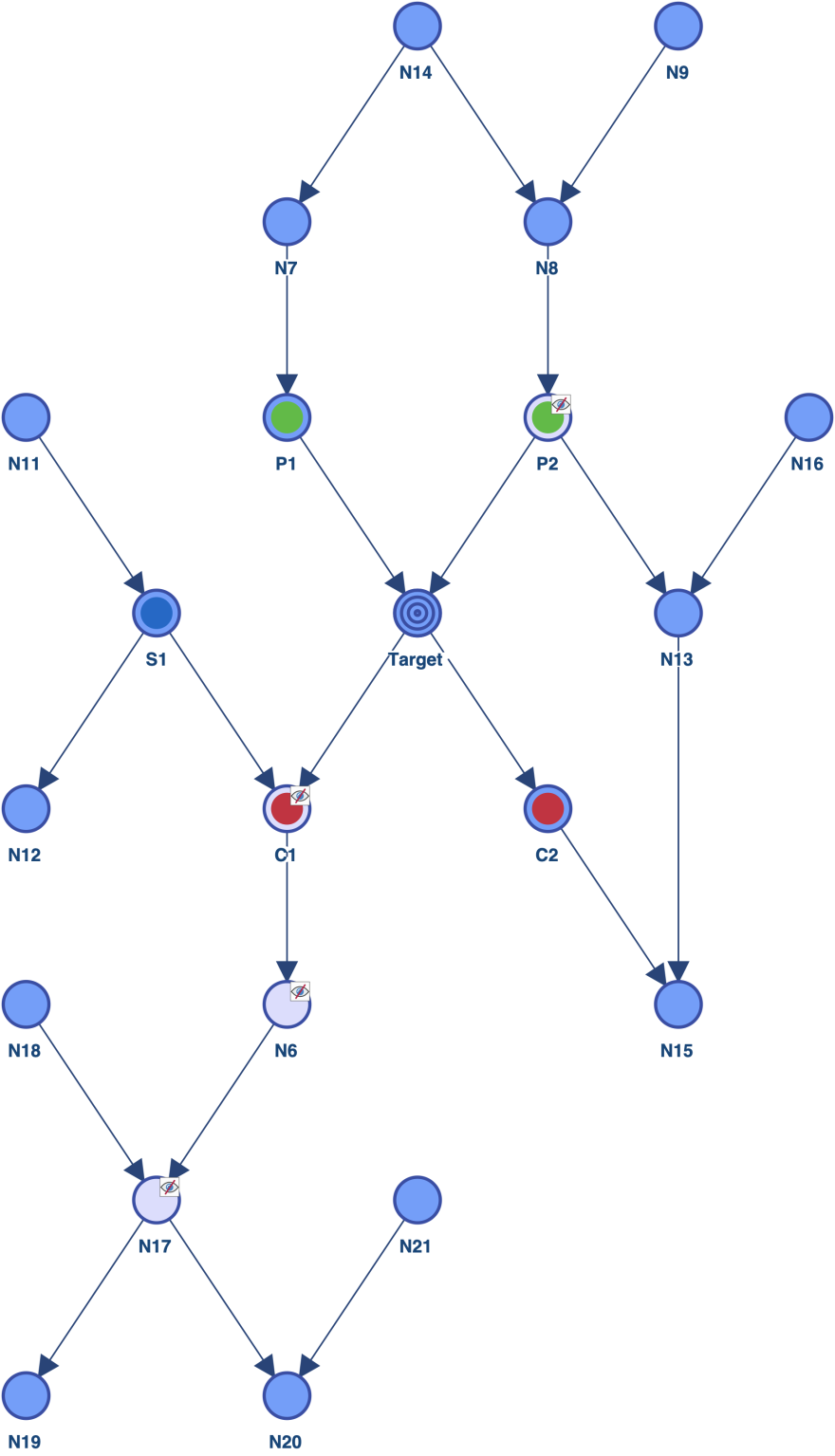
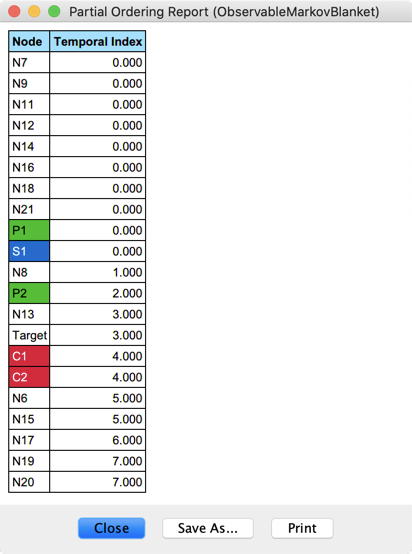
Below is the report that returns the indices of each node in the partial order. Here, 8 indices have been found: 0 for the root nodes and their 1-parent neighbors, and 7 for the two leaf nodes N19 and N20.
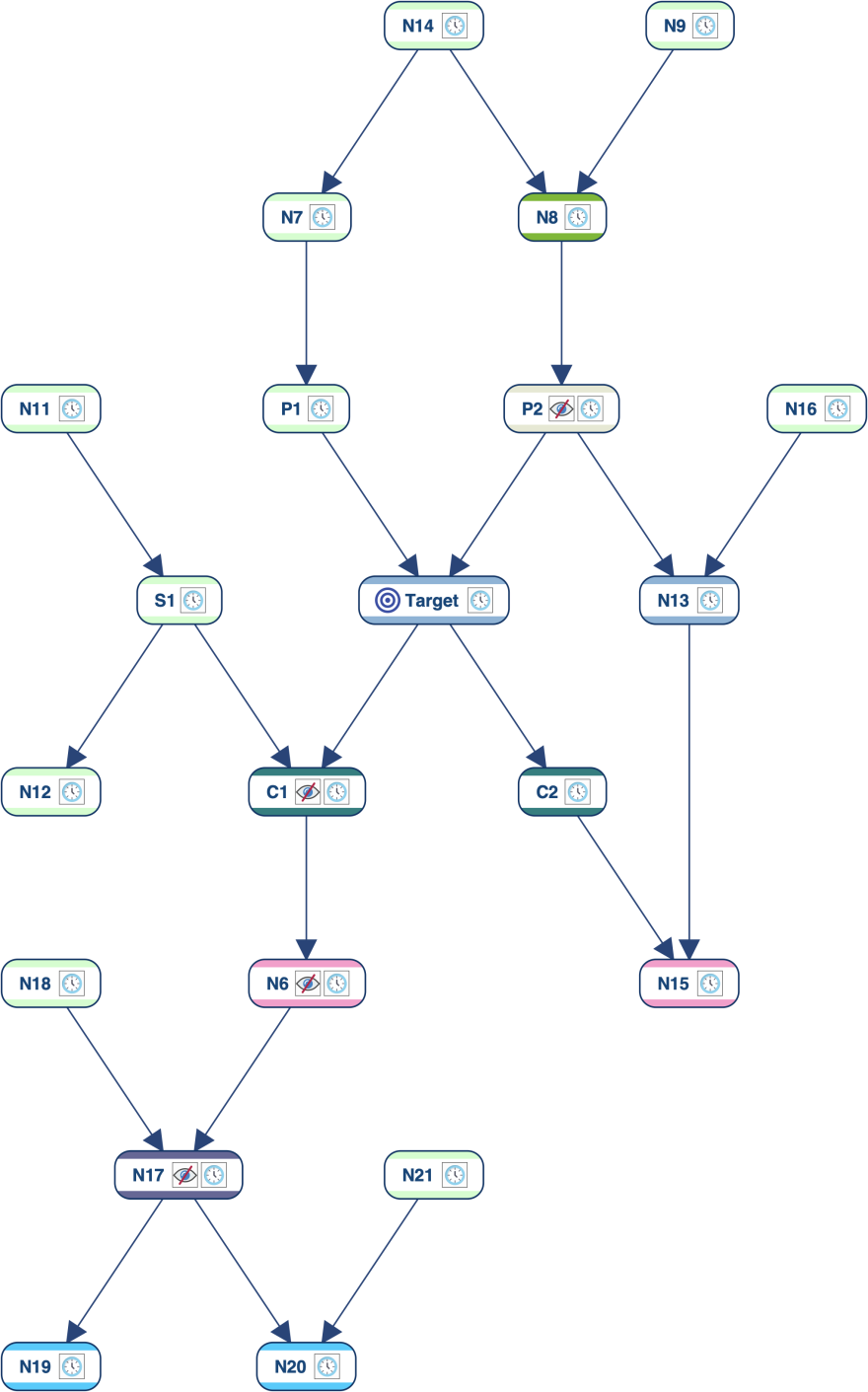
To highlight these indices, we created a class per index and associated a random color with each class.
A related meta-learning algorithm, Partial Order Learning, learns partial orders by using Data Perturbation.