
Cluster Interpretation: Dynamic Profile
Background & Context
- On this page, we present the Dynamic Profile for cluster interpretation as an alternative to Most Relevant Explanations for Cluster Interpretation.
- To provide further context for Most Relevant Explanations for Cluster Interpretation, we compare several other approaches that can help interpret individual Clusters:
- Setting Evidence for Cluster Interpretation: Posterior Distributions, Relationship with Target Node, Mosaic Analysis, Posterior Mean Analysis, Segment Profile Analysis, Histograms, Tornado Diagrams
- Optimization for Cluster Interpretation: Dynamic Profile, Target Optimization Tree
- More specifically, we compare all these approaches with regard to characterizing the state of the Cluster Node in the reference network.
- All analyses and instructions on this page refer to this reference network, which you can download here:
MaleClusters.xbl
Dynamic Profile for Cluster Interpretation
- We can use BayesiaLab’s optimization tools to work with more complex sets of evidence. One of these optimization tools is the Dynamic Profile.
- The Dynamic Profile uses a greedy search algorithm to simulate sets of evidence that maximize the probability of .
- It may seem counterintuitive to think of optimizing evidence to achieve membership in . After all, we cannot modify body measurements.
- However, we can think of those characteristics that assign a subject to most quickly as prototypical traits of .
- To start Dynamic Profile, select
Main Menu > Analysis > Target Optimization > Dynamic Profile. - In the Dynamic Profile Settings, we need to specify that we want to maximize the probability of by searching across Hard Evidence.
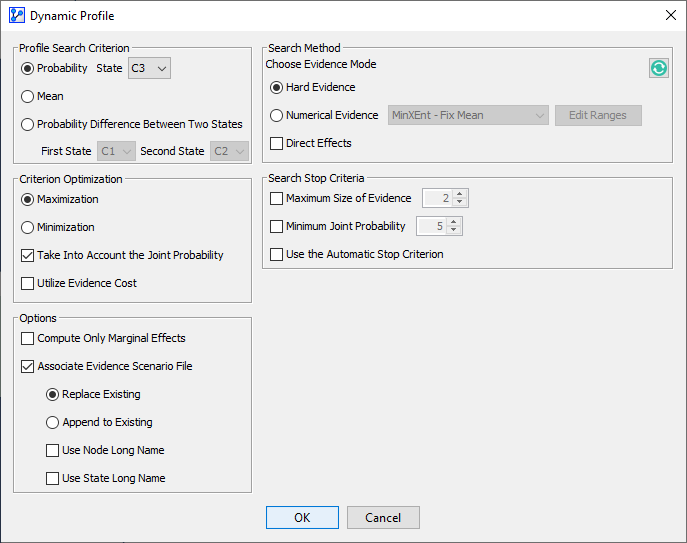
- Clicking OK starts the search and quickly produces a solutions table, which opens in a new window:
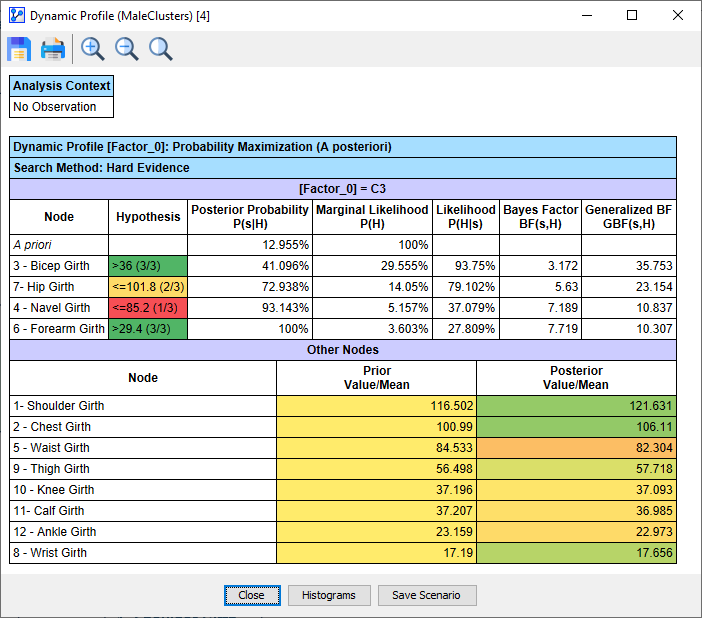
- The starting point is the row in the table marked A priori, which shows that , i.e., the marginal probability of .
- If we evaluate the hypothesis , the posterior probability increases, i.e., .
- In this case, the Bayes Factor is 3.172, meaning that with this hypothesis, membership is 3.172 times more probable than without it.
- Setting , the probability of membership increases further to 72.938%.
- With and , we reach a probability of 100%.
- As a result, we can interpret this set of evidence as a prototypical profile for a subject in :