
Experts. Data. GenAI.
Bayesia enables organizations to transform expert knowledge, data, and generative AI into transparent, explainable models for reasoning, simulation, diagnosis, risk analysis, and decision support under uncertainty.
The Bayesia ecosystem spans from desktop software for individual researchers to SaaS platforms and enterprise-scale solutions, supporting applications from scientific discovery in fields such as genetics and molecular biology to complex decisions in infrastructure, industrial systems, and public policy.
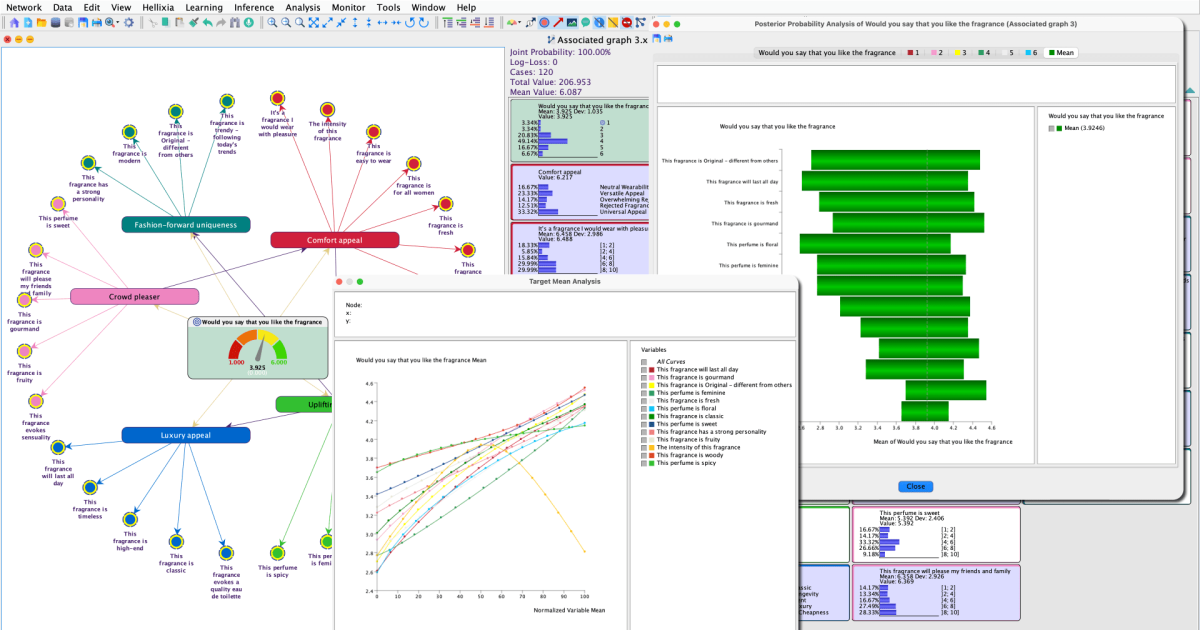
Conceptual Model
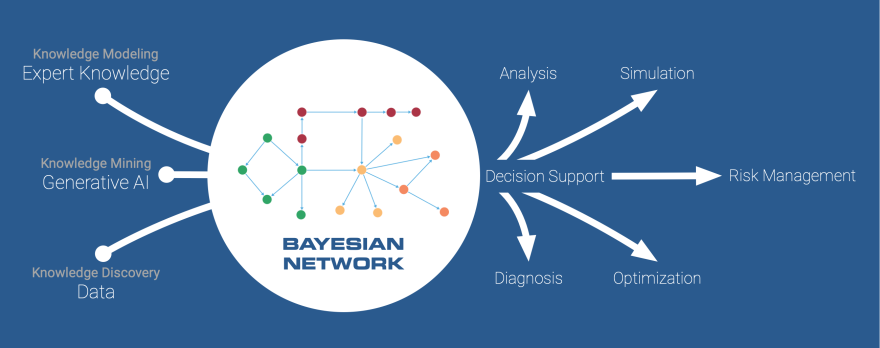
Technology and Ecosystem
One Bayesian foundation. Two product families.
Bayesia offers a comprehensive ecosystem of Bayesian technologies for modeling, analytics, troubleshooting, and decision support. Its integrated platform is centered on BayesiaLab, Hellixia, BEKEE, HellixMap, WebSimulator, and Bayesia Engine API. Beyond that tightly connected platform, Bayesia also provides standalone industrial solutions such as BEST for troubleshooting complex systems and BRICKS for probabilistic digital twins and large-scale relational system modeling.
Integrated BayesiaLab Platform
Standalone Industrial Solutions
BEST and BRICKS extend the Bayesia ecosystem with dedicated industrial solutions for troubleshooting, probabilistic digital twins, and large-scale relational modeling.
BEST
Standalone expert system for troubleshooting complex heterogeneous systems using symptoms, failure modes, service data, and guided corrective workflows.
BRICKS
Standalone framework for probabilistic relational modeling, risk-centric digital twins, and a three-phase methodology spanning knowledge modeling, system instantiation, and probabilistic querying.
Mission
Reasoning Closer to the Fabric of Reality
Most organizations make critical decisions with incomplete data, fragmented expertise, and conflicting information. Bayesia provides a framework for transforming those inputs into computable models that support diagnosis, reasoning, simulation, and optimization under uncertainty.
Solutions
Solutions for complex decisions.
Bayesia is designed for situations where decisions have to combine evidence, assumptions, causal reasoning, and explainable outputs.
Decision Support
Turn uncertainty into transparent recommendations, policy choices, and operational guidance.
Risk Management
Model sparse evidence, competing narratives, and uncertain futures with probabilistic structure.
Diagnosis and Root Cause Analysis
Infer hidden causes from symptoms, test results, observations, and system behavior.
Scenario Simulation
Explore interventions, compare possible futures, and quantify downstream effects before acting.
Knowledge Engineering
Formalize subject-matter expertise into computable models when data are absent, costly, or delayed.
Explainable AI
Use intelligible structures that can be inspected, challenged, and explained instead of black-box outputs.
Industrial Troubleshooting
Guide service, maintenance, and repair operations with symptom-driven Bayesian reasoning.
Probabilistic Digital Twins and Complex System Modeling
Represent large interconnected systems with relational probabilistic structure and actionable queries.
BayesiaLab Resources
From ecosystem strategy to hands-on BayesiaLab workflows.
The top of this draft introduces Bayesia’s conceptual model and product ecosystem. This final section narrows the focus to BayesiaLab itself, surfacing the same entry points, learning assets, deployment options, and support resources that are currently featured on the live Bayesia homepage.










Final CTA
Start with the problem you need to solve.
Whether you are formalizing expert knowledge, learning from data, modeling risk, diagnosing complex systems, or building probabilistic digital twins, Bayesia provides the tools and methodologies to move from uncertainty to insight.